

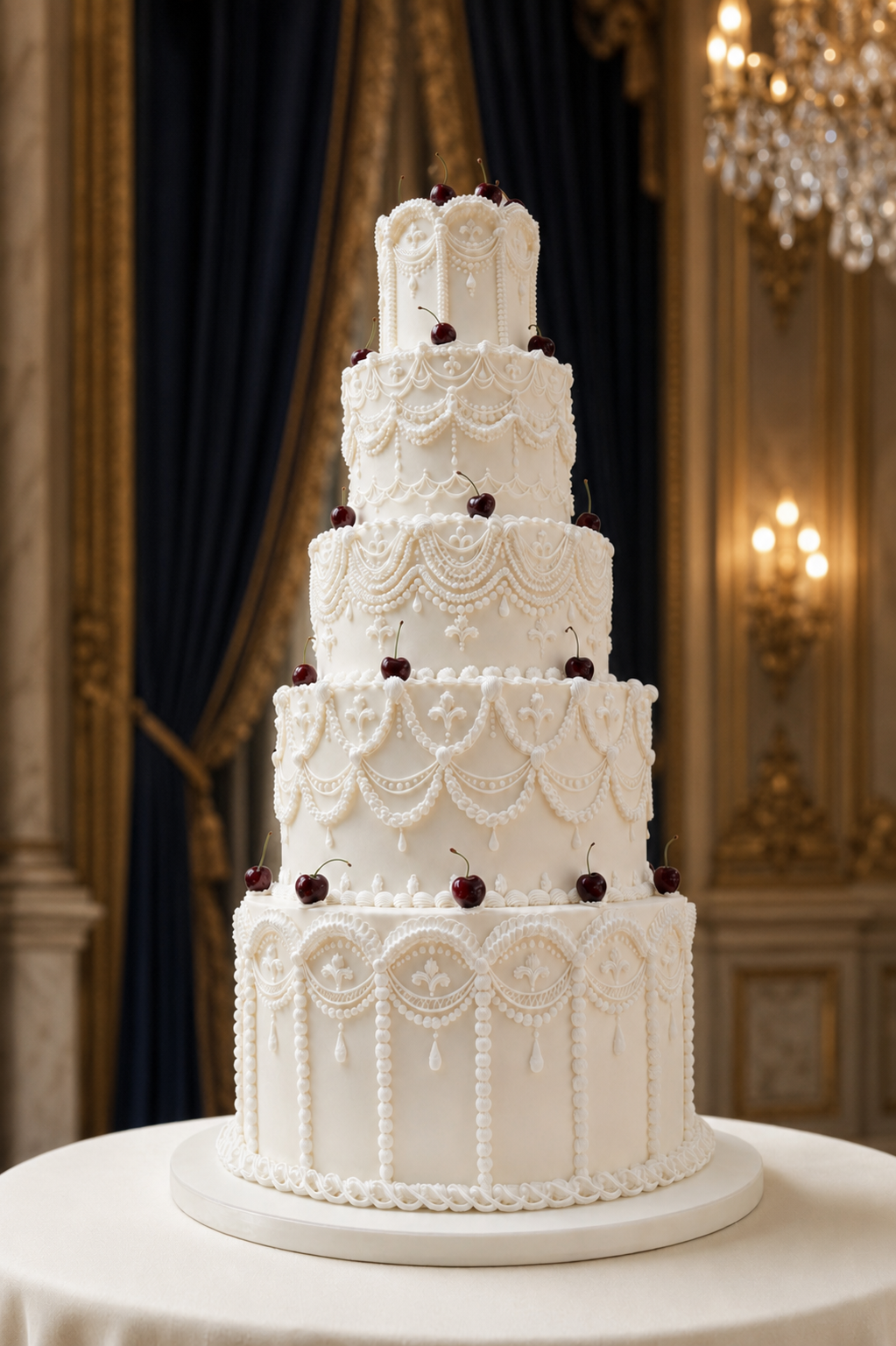
Royal icing is the oldest and most demanding finish in cake work, and the one fewest makers still offer. It’s what covered the tiers at state occasions and society weddings for two centuries, and it’s what we were classically trained in.
Most London cake studios will quote you fondant or buttercream. Very few will quote you royal icing at all — not because clients don’t want it, but because the technique takes years to learn and hours to execute, and it punishes any shortcut.
What royal icing actually is
Icing sugar and egg white, worked to a precise consistency, applied in thin coats and left to dry hard between each one. Nothing else. No plasticiser, no rolled sheet, no shortcuts.
What that produces is a finish nothing else replicates: a crisp, porcelain-smooth surface with genuinely sharp edges, and the ability to hold piped detail that stands proud of the cake without slumping. Lacework, filigree, brush embroidery, extension work, run-outs — the fine techniques all belong to royal icing, because no other medium holds a line that precisely.
Why so few makers offer it
Time, mostly. A royal-iced tier needs several coats, each dried before the next. Piped detail is applied by hand, element by element, with no way to speed it up and no way to correct a mistake invisibly. A single showpiece can take days.
Fondant, by comparison, is rolled and draped in an afternoon. It’s a perfectly good finish and we use it constantly. But it’s a different craft, and the two don’t look alike to anyone paying attention.
The skill has also simply thinned out. It was standard training a generation ago and is now a speciality — which is why a royal-iced cake reads as considered in a way that’s hard to put a finger on and impossible to fake.
When to choose it
Royal icing suits formality. A cathedral or a country house, a black-tie reception, a state or civic occasion, a heritage venue where a soft modern finish would look out of place. It photographs beautifully because the light catches the raised detail rather than flattening across a smooth surface.
It’s also the practical choice in one respect: it’s stable at room temperature and stays crisp through a long day. Buttercream needs refrigeration, which is difficult in a warm venue or direct summer sun.
It’s less suited to soft, romantic or rustic designs. If that’s the direction you’re going, fondant with sugar flowers is usually the better answer, and we’ll tell you so.
What it costs
Royal icing sits at the top of our price ladder. Multi-tiered royal-iced showpieces typically run £3,000 to £4,000 and above, against celebration cakes from £350 and wedding cakes from £950.
The difference is hours, not ingredients. Our guide to what a bespoke cake costs breaks down exactly where that time goes.
Lead time
Because of the drying between coats and the hand work involved, royal-iced commissions need the earliest start of anything we make. Six months is the guide for a wedding, and more if the design is ambitious. There’s more detail in our guide to ordering lead times.
Talk to us about a royal-iced cake
If you’ve seen a cake with piped lacework or fine raised detail and wondered how it was done, this is the answer — and it’s the work we most enjoy.
Check availability for your date, see the full range of wedding cakes, or read our frequently asked questions.