

When we tell you a cake serves sixty, we mean sixty guests get a proper slice on a plate. That sounds obvious. In cake, it isn’t.
Two ways to slice a cake — and why the difference matters
There are two conventions in use across the industry, and they are not close to each other.
A finger slice measures 1 inch × 1 inch × 4 inches high. Roughly the width of your thumb. It’s the traditional way to serve very rich cake, and it’s how a great many quotes are calculated.
A dessert slice measures 1 inch × 2 inches × 4 inches high. Twice the cake. It’s the portion you’d expect if cake is being served as your dessert course, plated, with a fork.
We quote in dessert slices. Always. So when two quotes both say “serves 100”, ours is physically twice the cake — and the price should be read in that light.
We’re not saying this to be difficult about competitors. We’re saying it because it’s the single most common reason couples end up confused when comparing cake quotes, and because it’s the difference between your guests receiving a mouthful and receiving a dessert. When you’re comparing, ask which slice size the number is based on. It’s a fair question and any good cake maker will answer it plainly.
Servings by tier size
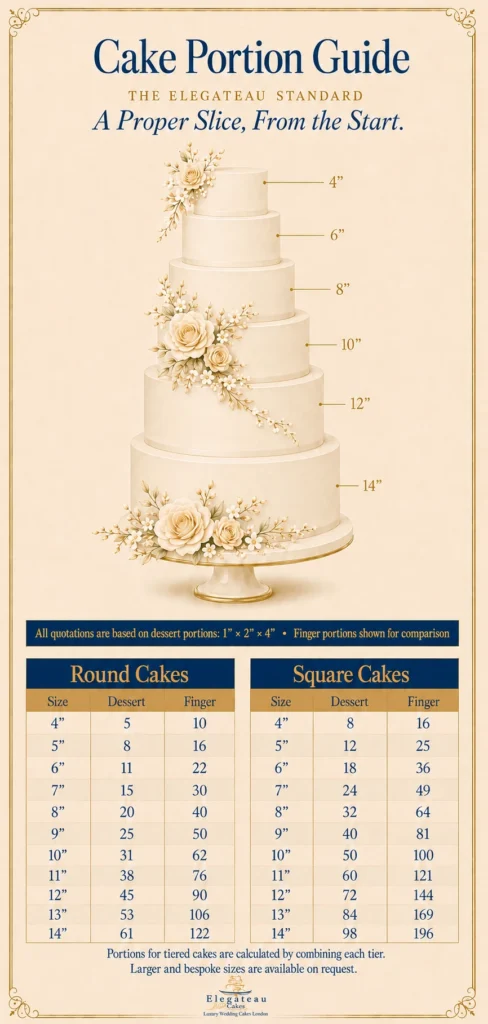
All Elegateau quotations are based on dessert portions — 1″ × 2″ × 4″.
These figures are a conservative minimum. Dessert slices are the numbers we quote from.
| Tier size | Dessert slices (how we quote) | Finger slices |
|---|---|---|
| 4″ round | 5 | 10 |
| 4″ square | 8 | 16 |
| 5″ round | 8 | 16 |
| 5″ square | 12 | 25 |
| 6″ round | 11 | 22 |
| 6″ square | 18 | 36 |
| 7″ round | 15 | 30 |
| 7″ square | 24 | 49 |
| 8″ round | 20 | 40 |
| 8″ square | 32 | 64 |
| 9″ round | 25 | 50 |
| 9″ square | 40 | 81 |
| 10″ round | 31 | 62 |
| 10″ square | 50 | 100 |
| 11″ round | 38 | 76 |
| 11″ square | 60 | 121 |
| 12″ round | 45 | 90 |
| 12″ square | 72 | 144 |
| 13″ round | 53 | 106 |
| 13″ square | 84 | 169 |
| 14″ round | 61 | 122 |
| 14″ square | 98 | 196 |
Square tiers serve considerably more than round tiers of the same measurement — a 10 inch square holds around 60% more cake than a 10 inch round. If numbers are tight and the design allows it, square is the more efficient choice.
The table stops at 14 inches. We don’t. Larger tiers, bespoke shapes and sculpted pieces are all part of what we do — the biggest simply travel in sections and are assembled at your venue. If your guest numbers run past what’s shown here, tell us and we’ll design for them.
Some common combinations
| Cake | Dessert slices |
|---|---|
| Two tiers — 6″ + 8″ round | 31 |
| Two tiers — 8″ + 10″ round | 51 |
| Three tiers — 6″ + 8″ + 10″ round | 62 |
| Three tiers — 8″ + 10″ + 12″ round | 96 |
| Four tiers — 6″ + 8″ + 10″ + 12″ round | 107 |
| Three tiers — 6″ + 8″ + 10″ square | 99 |
Traditional fruitcake
Fruitcake is the exception. It’s dense and very rich, so it’s served in finger slices by tradition — which means a fruitcake tier yields roughly twice the servings of the same tier in sponge. If you’re having a fruitcake tier, we’ll quote it that way and tell you clearly.
You don’t have to serve every tier
If you want the height and drama of a tall cake but don’t need to feed a crowd, we can build display tiers from decorated dummy forms — once finished, they’re indistinguishable from cake. Guests are then served from cutting cakes kept back in the catering kitchen.
Cutting cakes are plainer, shorter (usually 3 to 4 inches) and generally square or rectangular, made purely to hit a number. We’ll often supply several to make up the total. It’s the most efficient way to get a showpiece and feed everyone.
Tell your venue how the cake was quoted
Once the cake is at your venue, how it’s cut is in your caterer’s hands. Pass on that it’s been quoted in dessert slices at 1 inch × 2 inches, and they’ll know exactly what to do. It takes one line in an email and it’s the surest way to make sure the numbers work out on the night.
Not sure what you need?
Tell us your guest numbers and how you’d like the cake served, and we’ll do the arithmetic. Get in touch — or read our frequently asked questions.