



People often ask what makes a bespoke cake cost what it does. Part of the answer is time — the hand finishing, the sugar work, the days some designs take. The rest of it is sitting on our shelves.
Materials at this level behave differently. A paste that tears when rolled thin means no lifelike petals. A lustre that dulls when it dries means a cake that photographs flat. Most of what separates a good cake from a memorable one happens long before decorating begins, in what you choose to work with.
We use Squires Kitchen for most of it — a British brand making professional-grade sugarcraft materials. Below is what’s genuinely in our studio and what each thing is for. No affiliate links, nothing sponsored. Just what we reach for.
Florist paste

For ultra-fine sugar flowers, wired petals and detail that has to hold its shape while staying feather-light.
It rolls out remarkably thin without tearing, then dries firm and smooth. That combination is rarer than it sounds, and it’s what allows a sugar rose to read as a real one at arm’s length. It’s behind almost every floral wedding cake we make.
Metallic lustre dust

A fine edible powder that adds shimmer to sugar work, chocolate and icing. It can be brushed on dry, mixed with alcohol and painted, or dusted over a finished piece.
The finish stays vibrant rather than chalky, and the range runs from classic golds and silvers through to rose tones. It’s what gives a gilded tier its depth under venue lighting.
Gel food colours

For colouring fondant, buttercream, royal icing and batter.
A little goes a long way, and crucially the colour holds true through baking and drying rather than fading or shifting. When a cake has to match a specific shade from a dress or a table setting, that reliability is the whole job.
Edible glue
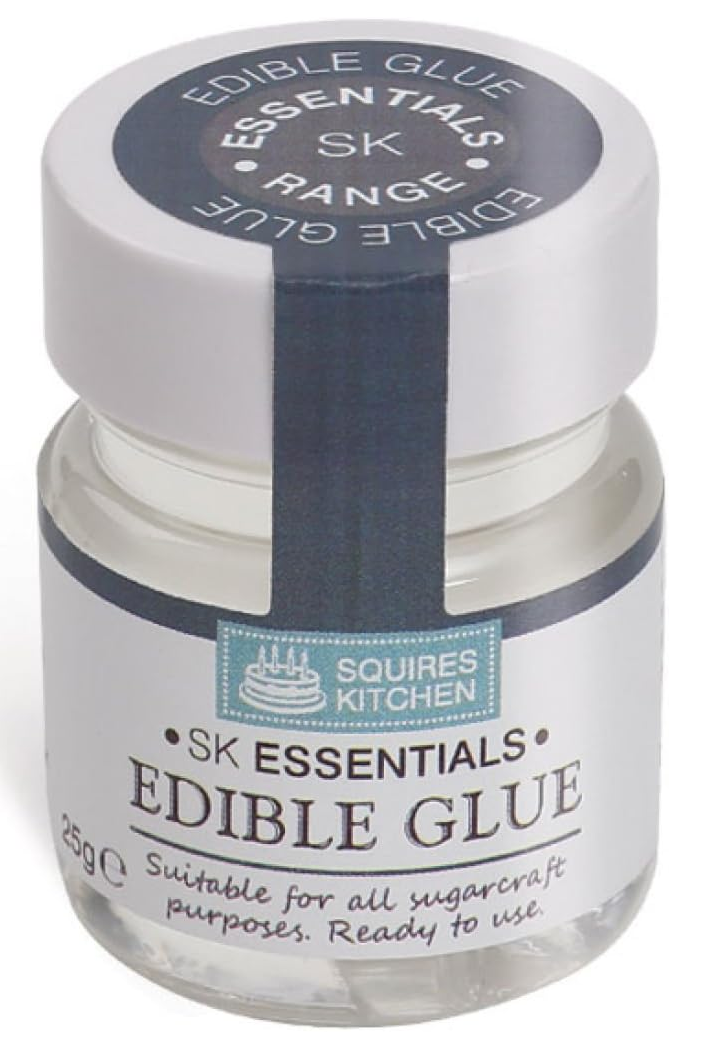
For securing sugar decorations, wafer paper and fondant detail.
It dries clear and holds firm, which matters as much for a heavy sugar flower as for a scatter of tiny pearls. Unglamorous, and we’d struggle without it.
Royal icing mix

For crisp piped detail, lacework and smooth flooded finishes.
Royal icing is the most demanding finish we offer and the one fewest makers still work in classically. It needs a silky, controllable texture that holds a line without slumping — the difference between piping that looks hand-drawn and piping that looks precise.
Albumen powder

A high-quality egg white alternative for royal icing and meringue.
It gives structure and shine with more consistency than fresh whites, and it removes a food safety question when a cake will stand at room temperature through a long reception.
Edible silver leaf

Pure edible silver, applied to tiers, chocolate work and sugar detail.
Used sparingly it does something no paint can replicate — it catches and moves light as guests walk past. Used heavily it looks like costume jewellery. Restraint is most of the skill.
Isomalt

For glass-like decoration, pulled sugar and sculptural elements.
It stays crystal clear rather than clouding, and it’s more forgiving to work with than traditional pulled sugar. It’s how you get shards, panes and frozen-looking structures that hold up through an evening.
Icing whitener

For brightening fondant, buttercream and royal icing to a true white.
Untreated icing carries a faint yellow cast that the eye notices immediately next to a wedding dress. This neutralises it. One of those details nobody consciously registers, and everybody sees.
Edible wafer paper

For delicate flowers, ruffles, sails, feathers and lace-like elements — and for edible printing.
Lightweight and flexible, it adds height and movement without weight, which matters enormously on a tall cake where every gram sits on the tier below.
Why any of this matters to you
You’ll never see most of these materials. What you see is whether the white reads as white, whether the sugar flowers look real, whether the gilding still catches the light at nine in the evening.
That’s the part of a bespoke commission that’s hard to quantify and easy to feel — and it’s a large part of why a hand-made cake sits where it does on price. If you’d like the fuller picture, our frequently asked questions cover what drives cost, and our portion guide explains how we size and quote.
If you’re a maker rather than a client: we used to stock supplies like these and we’re weighing up whether to sell them again online. You can register your interest here and tell us what you’d want us to carry.
Or have a look at what all of it goes into — our wedding cakes.
Nice list of products. I’ll give them a try.